The UK government’s Warm Homes Plan names solar shading and blinds as priority home upgrades
The government’s landmark Warm Homes Plan, published in January 2026, sets out a £15 billion investment in upgrading British homes. Alongside heat pumps, solar panels, and insulation, the plan explicitly identifies blinds, external shutters, and solar shading as recommended measures to protect homes from overheating. For the first time, passive cooling has been placed at the heart of national home upgrade policy.

A plan for warmer winters and cooler summers
When the government published the Warm Homes Plan in January 2026, the headline figures were hard to ignore: £15 billion of public investment, up to five million homes upgraded by 2030, and the ambition to lift a million households out of fuel poverty. The plan is, as its name suggests, primarily concerned with keeping British homes warm and affordable to heat.
But buried within the document is something that will matter just as much as the heating agenda in the years ahead: a clear and explicit government commitment to passive cooling as an essential component of the home upgrades Britain needs. And the measures it recommends are ones that James Robertshaw has been manufacturing and installing for over 160 years.
What the plan actually says about solar shading
The relevant section of the Warm Homes Plan is titled “Upgrading buildings for year-round performance”, and its language is unambiguous. The government states that building upgrades must deliver year-round comfort, not just winter warmth, and that integrating adaptation into home upgrade policy is essential to mitigate overheating and other climate-related impacts.
The plan goes on to specify the measures it considers most effective and most practical. It states that priority should be given to low-cost, low-regret interventions, and lists these explicitly as: internal blinds, external shutters, reflective window films, and cooler building materials. These are described as measures that enhance thermal comfort during hot weather and, when paired with active cooling, help mitigate energy bill increases.
Crucially, the government commits to going further than advice alone. Over the course of this Parliament, it intends to embed passive cooling measures within capital-funded schemes focused on improving the homes of low-income households and social housing. In practical terms, this means government money will be directed towards the very products that form the core of the James Robertshaw product range.
The science that shaped the policy
The Warm Homes Plan does not arrive at these conclusions speculatively. It draws on peer-reviewed academic research to make the case for passive cooling, including a monitoring study in Camden, London, that investigated exactly how much difference blinds and shutters make in a real residential setting.
The study focused on a mid-rise apartment that had been converted from offices and lacked cross-ventilation, making it typical of many urban homes most at risk from summer overheating. The results were striking. During peak summer, bedroom temperatures in the unshaded apartment reached 47.5°C when outdoor temperatures peaked at 28°C. That is not a liveable environment, and it is not an unusual one: urban flats, terraced houses, and properties with significant south-facing glazing face exactly this kind of heat stress with increasing frequency as UK summers intensify.
The study assessed several interventions: internal aluminium venetian blinds, high-performance fabric blinds, external aluminium venetian blinds, and a night-time window opening strategy. External shading combined with night-time ventilation eliminated overheating risk entirely, cutting indoor temperatures by between 11 and 18 degrees Celsius. Internal blinds alone reduced temperatures by between 9 and 13 degrees. The conclusion was that external shading delivers the greatest benefit, but that internal shading still achieves close to three-quarters of the same cooling effect.
A separate Manchester study cited in the plan estimated the cost of shading adaptations at between £300 and £2,500 depending on type and installation, making them among the most cost-effective interventions available. For context, that compares very favourably with the £7,500 government grant available for heat pump installations.
Why this matters now
The overheating problem in UK homes is not a future risk. It is a present one. Research cited in the Warm Homes Plan identifies urban high-density flats and terraced houses in denser locations as the buildings most vulnerable to overheating, and notes a clear correlation between those most vulnerable to heat stress and the groups of people most likely to live in those property types. In other words, the households least able to afford air conditioning are often the ones who need cooling most.
The plan also acknowledges that active cooling, while valuable, creates its own pressures. Air conditioning and air-to-air heat pumps increase electricity demand, add to energy bills, and place additional load on the grid. Passive cooling measures reduce the need for active cooling in the first place, making them a more efficient and more sustainable first line of defence.
There is a further factor worth noting. The Warm Homes Plan also aims to put solar panels on the roofs of up to three million more homes by 2030. Solar panels are excellent at generating electricity, but they also increase the thermal load on the roof structure below them. As the number of solar-equipped homes grows, so does the importance of managing the heat that builds up inside those homes during summer. Shading solutions are a natural complement to the rooftop solar revolution the government is backing.
James Robertshaw’s solar shading solutions
At James Robertshaw, solar shading is not a new product category or a response to a current trend. It has been central to what we do since 1860. Our range of exterior and interior shading solutions spans awnings, blinds, canopies, pergolas, and bespoke solar shading systems, all designed and manufactured to perform reliably in the British climate and to complement the buildings they protect.
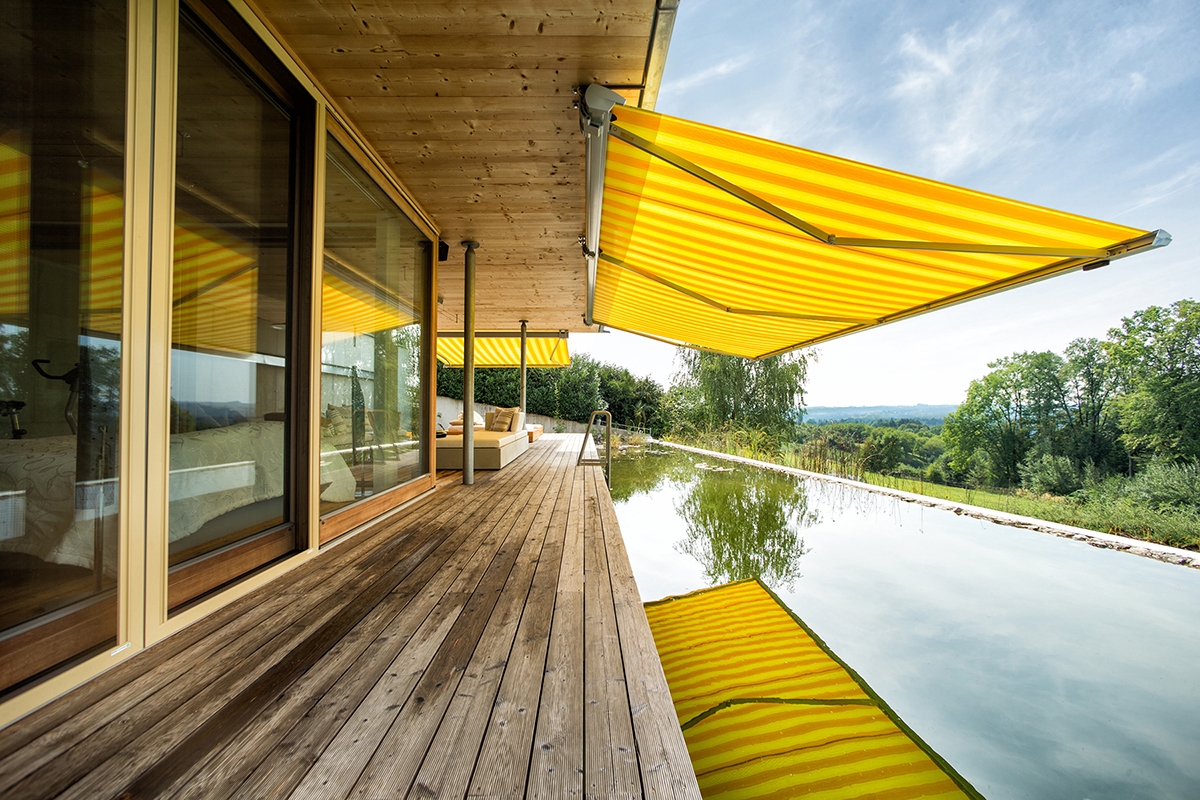
For residential properties, our folding-arm awnings and exterior blinds provide exactly the kind of external shading that the government’s research identifies as most effective at reducing indoor temperatures. For commercial and hospitality settings, our pergola and canopy range creates shaded outdoor environments that remain comfortable and usable throughout the warmest months. And for properties where external shading is not practical, our interior blind range delivers meaningful cooling benefit as the Camden study demonstrates.
Every solution we supply is bespoke. Dimensions, fabrics, colours, and configurations are all specified around the individual building and the customer’s requirements. That flexibility matters because no two buildings overheat in exactly the same way, and the most effective shading solution for a south-facing Victorian terrace is different from the one that works best for a modern glazed apartment or a commercial hospitality terrace.
Looking ahead
The Warm Homes Plan represents a generational shift in how the government thinks about home performance. For decades, energy efficiency policy focused almost exclusively on retaining heat in winter. The January 2026 plan marks the first time that managing heat in summer has been given equivalent weight in national policy, backed by a commitment to fund passive cooling measures through government schemes.
The government has also committed to publishing a UK Cooling Outlook in 2026, which will consolidate the evidence base and identify further opportunities for sustainable cooling solutions. As that conversation develops, and as funding for passive cooling measures begins to flow through government schemes, the importance of having a trusted, experienced supplier of solar shading solutions will only grow.
James Robertshaw has been that supplier for businesses and homeowners across the UK for over 160 years. If you are thinking about how to manage heat in your home or commercial property, whether in response to the Warm Homes Plan or simply because you want a more comfortable environment this summer, we would be glad to help.
Find out more
Contact the James Robertshaw team to discuss your solar shading requirements, explore the options available for your property, or find out more about our full range of exterior and interior shading solutions.